News
Prof. Jacek Młynarski, prof. Agnieszka Szumna and MSc. Jakub Durka awarded with NCN grants!
Loading...
Loading error
Prof. Daniel Gryko is the laureate of the Scientific Award of the President of the PAS
Loading...
Loading error

Loading...
Loading error
Loading...
Loading error

Dr. Anna Domżalska-Pieczykolan and prof. Bartłomiej Furman publication in Angewandte Chemie International Edition
Loading...
Loading error

Loading...
Loading error

International scientific cooperation of Dr. Marcin Górecki resulted in an article in Angewandte Chemie International Edition
Loading...
Loading error

Loading...
Loading error
Loading...
Loading error
Prof. Jacek Mlynarski’s team, in collaboration with chemists from the Faculty of Chemistry at Adam Mickiewicz University, has published a study in ACS Catalysis devoted to the use of machine learning for predicting reactivity and enantioselectivity in asymmetric catalysis. The authors demonstrated that even small, but carefully collected and internally consistent experimental datasets can be used to build useful models that support decision-making in the laboratory. The models were developed for two reactions catalyzed by chiral magnesium complexes: chalcone epoxidation and the asymmetric thia-Michael reaction, and their predictions were experimentally validated using previously untested substrates. The results show that models employing AI algorithms can not only analyze existing data, but also predict the outcomes of experiments that have not yet been performed, thereby reducing the need for the classical trial-and-error approach. The study thus points to a practical route for applying AI to the development of new catalytic reactions, even when only small datasets are available.
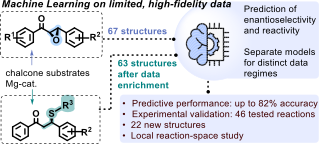
P. Baczewska, D. Nowak, J. Jaszczewska-Adamczak, R. A. Bachorz, M. Hoffmann, J. Mlynarski, “Predicting Reactivity and Enantioselectivity from Small Experimental Datasets: A Case Study in Asymmetric Magnesium Catalysis”, ACS Catal.