Publication by Dr. Kajetan Dąbrowa in Angewandte Chemie International Edition
The rapidly growing demand for lithium-ion batteries has made lithium one of the most important raw materials of the modern economy. However, current lithium production routes remain resource- and energy-intensive, and a significant fraction of this element can be lost in the form of solid salt mixtures generated during brine concentration.
For this reason, recent years have seen intensive research into approaches based on the selective capture and transport of lithium salts by small-molecule extractants with well-defined structures. However, most molecular extractants reported so far are too structurally complex and costly for practical large-scale applications.
In our latest study, selected by the editors of Angewandte Chemie as a Very Important Paper, we demonstrated that compounds known for decades and previously regarded as sodium-selective receptors can in fact efficiently and selectively extract lithium chloride. By introducing only a minor modification to these simple molecules, we developed a low-cost and readily accessible molecular extractant with an estimated synthesis cost below 1 USD per gram.
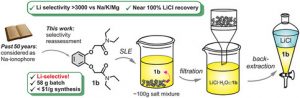
The developed system enabled near-quantitative extraction of lithium chloride from 100 g of a solid salt mixture mimicking materials generated during industrial processing of brines from the Salar de Atacama, one of the world’s most important lithium sources. Although lithium chloride accounted for less than 5% of the starting material, the recovered product reached a purity exceeding 95%.
These findings demonstrate that simple molecular receptors may open a new route for lithium recovery from challenging solid materials, such as waste salt fractions and by-products generated during lithium production from brines. The study also indicates that this approach may be further developed toward selected battery-derived materials, which is particularly relevant in the context of future lithium recycling.