New paper in Nature Communications by Dr. Jarosław Granda
The synthesis of enantiopure compounds is a fundamental goal in organic chemistry driven by the critical role of chirality in molecular recognition and biological activity. Traditionally, the discovery of new enantioselective reactions remained mostly human-centric slow and resource intensive manual experimental endeavor.
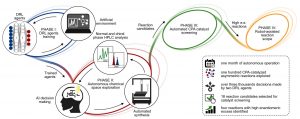
In a study published in Nature Communications, Dr Granda’s group present a robotic platform the discovery of asymmetric reactions. The platform brings together AI-decision making, robotic experimentation and automated chiral analysis in a single end-to-end workflow. It can autonomously explore asymmetric reaction space, identify chiral products, screen catalysts, and perform reaction scope investigation.
The authors exemplified this approach for the discovery of chiral phosphoric acid catalyzed reactions; by exploring 100 reactions it has discovered four new enantioselective transformations.
P. Klochowicz, A. F. Kassir, C. Parida, J. M. Granda, „Reinforcement learning guided robotic platform that investigates and discovers asymmetric reactions”, Nat. Commun.